If you love fish burgers, you have to try this Fish Katsu Burger! It starts with a crispy homemade fish cutlet tucked into a soft bun with shredded cabbage, tonkatsu sauce, and a creamy yuzu kosho shiso corn tartar that adds just the right amount of citrusy heat.
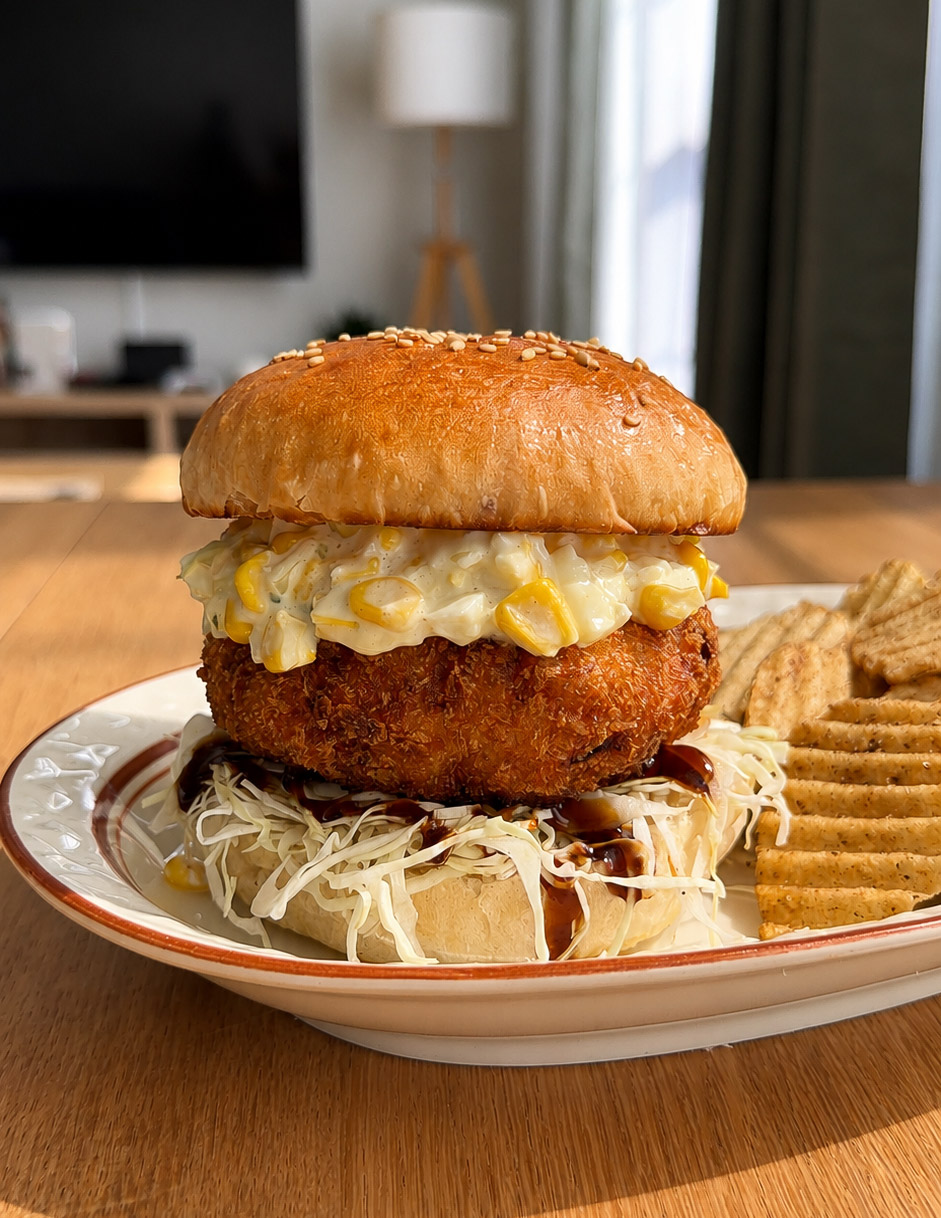
Table of Contents
Ingredients and Substitutions
You only need a handful of simple ingredients to make this Fish Katsu Burger at home. Here is the main ingredients you’ll need:
- White fish: I recommend cod for its mild flavour and flaky texture. Haddock, pollock, or hoki also work well.
- Onion: Added to both the fish patty and tartar sauce for flavour and texture.
- Flour: Helps bind the fish patty and is also used for breading.
- Egg: Egg white binds the fish patty and whole eggs are used for breading and the tartar sauce.
- Sake: Helps season the fish and reduces any fishy aroma.
- Japanese panko breadcrumbs: I highly recommend using Japanese panko rather than regular breadcrumbs or American-style panko. The flakes are larger and airier, creating a lighter, crispier coating that’s characteristic of Japanese katsu.
- Neutral oil: Use a neutral, high smoke point oil such as canola oil, vegetable oil, sunflower oil, rice bran oil, or peanut oil for frying.
- Sweet corn – Fresh, frozen, or canned all work. Fresh or frozen have the best texture.
- Shiso leaves – Adds a fresh, herbaceous flavour. If unavailable, simply leave it out.
- Japanese mayonnaise: Homemade or Kewpie mayonnaise. It gives the tartar its rich flavour.
- Yuzu kosho: A Japanese citrus pepper paste that adds a bright, spicy kick.
- Lemon juice: Brightens the tartar sauce.
- Burger buns: Any soft fluffy bun.
- Shredded cabbage: Adds some freshness and crunch.
- Tonkatsu sauce: The classic sweet and savoury sauce for Japanese katsu.
How to Make Fish Katsu Burger
Fish burgers are actually quite easy to make if you break it down. Here’s an overview:
- Prepare the fish by finely mincing about one-quarter into a paste and coarsely chopping the rest. Mix with the remaining patty ingredients and shape into patties.
- Chill the patties, then coat them in flour, egg, and panko.
- Deep fry until golden brown and cooked through.
- Mix together the yuzu kosho corn tartar.
Assemble the burgers with shredded cabbage, tonkatsu sauce, the fish katsu, and plenty of tartar sauce.
VIDEO: Watch How to Make It
Lisa’s Recipe Tips
- Pat the fish dry: Removing excess moisture helps the patties hold together and gives the panko a crispier finish.
- Use two textures of fish: Finely mincing a portion of the fish helps bind the patties while the larger pieces stay flaky and juicy.
- Don’t skip chilling the patties: A short rest in the refrigerator helps them keep their shape during frying.
- Maintain the oil temperature: Fry at around 170°C (340°F). If the oil is too hot, the coating browns before the fish cooks. Too cool and the coating absorbs excess oil.
Serving Suggestions
This Fish Katsu Burger is quite heft and delicious on its own, but it also pairs well with:
- FROZEN KETTLE CHIPS!! my favourite. I like to eat it with the burger.
- French fries or potato wedges
- Lotus root chips
- Japanese potato salad
- Coleslaw
- Corn on the cob
- Pickles
- A simple green salad
How to Store and Reheat Leftovers
The fish patties are best enjoyed fresh, but leftovers store well.
- Refrigerate: Store the fried fish patties separately in an airtight container for up to 2 days.
- Freeze: Freeze the cooked patties for up to 2 months.
- Reheat: Bake or air fry until hot and crispy. Avoid microwaving, as the coating will soften.
- Tartar sauce: Store separately in the refrigerator for up to 2 days.
Recipe FAQ
Yes. Shape the patties up to one day in advance and keep them refrigerated until ready to bread and fry.
Yes. Spray the breaded patties lightly with oil and air fry at 390°F (200°C) for 10–12 minutes or until golden and cooked through. The coating won’t be quite as crisp as deep frying but will still be delicious.
Yes. Arrange the breaded fish patties on a wire rack set over a baking tray and generously spray or brush both sides with oil. Bake at 425°F (220°C) for 15–20 minutes, flipping halfway through, until golden and cooked through. The coating won’t be quite as crispy or evenly browned as deep frying, but they’ll still be delicious.
More Katsu Recipes
- Katsudon (Pork Cutlet Rice Bowl)
- Air Fryer Chicken Katsu
- Katsu Sando (Pork Cutlet Sandwich)
- Tonkatsu (Japanese Pork Cutlet)
- Tofu Katsu Sando
- Tofu Katsu
Enjoy! If you make this Fish Katsu Burger recipe, I’d love to hear what you think! Leave a comment and rating below, and if you share it on social media, tag me on Instagram @Okonomikitchen. I can’t wait to see your creations!
Print
Fish Katsu Burger
- Total Time: 45 minutes
- Yield: 4 servings
- Diet: Pescatarian
Description
If you love fish burgers, you have to try this Fish Katsu Burger! It starts with a crispy homemade fish cutlet tucked into a soft bun with shredded cabbage, tonkatsu sauce, and a creamy yuzu kosho corn tartar that adds just the right amount of citrusy heat.
Ingredients
Fish Patties
- ~1 lbs (480 g) cod or other firm white fish, skinless
- 1/2 (60-80 g) onion, finely minced
- 1 (38 g) large egg white
- 1.5 tbsp (20 g) Japanese mayonnaise
- 1 tbsp sake
- 1/2 tsp salt
- 1/4 tsp white pepper
- 1/2 tsp sugar
- 3 tbsp (21 g) all-purpose flour
Breading
- 1/3 cup all-purpose flour
- 1 beaten egg
- 1 1/2 cup panko breadcrumbs
- neutral oil, for frying
Yuzu Kosho Corn Tartar
- 2 hard-boiled egg, finely chopped
- 1/3 (60 g) onion, finely diced
- 2/3 cup (100 g) sweet corn kernels, blanched or lightly grilled
- 4–6 shiso leaves, finely minced (or 2–3 tsp shiso paste)
- 1/2 cup Japanese mayonnaise
- 2 tsp lemon juice
- 1–1 1/2 tsp (5 g) yuzu kosho, to taste
For Assembly
- 4 large burger buns
- finely shredded cabbage
- tonkatsu sauce
Instructions
- Prepare the fish patties: Pat the fish dry. Finely mince or mash about 1/4 of the fish into a paste, then coarsely chop the remaining into roughly 1 cm pieces.
- Combine the fish, onion, flour, egg white, sake, salt, white pepper, and sugar. Mix gently just until everything comes together—avoid overmixing. Divide into 2 equal portions and shape into patties slightly wider than the burger buns. Refrigerate for 20–30 minutes.
- Bread the patties: Coat each patty in flour. Dip into the beaten egg. Coat evenly with panko, gently pressing the crumbs to adhere.
- Fry: Heat oil to 170°C (340°F). Fry for 3–4 minutes per side, or until the coating is deep golden brown and the fish is cooked through. Drain on a wire rack, keeping it vertical for 10 seconds to let the excess oil drip off.
- Make the Yuzu Kosho Corn Tartar: Combine the chopped egg, onion, corn, shiso, mayonnaise, lemon juice, and yuzu kosho. Mix until well combined. Refrigerate until ready to serve.
- Assemble the burgers: Spread a little mayo on the bottom bun. Place a generous handful of shredded cabbage on the bottom bun. Drizzle the cabbage with tonkatsu sauce. Top with the fish katsu patty. Spoon a generous amount of Yuzu Kosho Corn Tartar over the fish. Finish with the top bun and serve immediately.
- Prep Time: 30 minutes
- Cook Time: 15 minutes
- Category: Main course
- Method: Deep frying
- Cuisine: Japanese
Nutrition
- Serving Size: 1 fish katsu burger
- Calories: 710
- Sugar: 11 g
- Sodium: 980 mg
- Fat: 31 g
- Saturated Fat: 5.8 g
- Unsaturated Fat: 23 g
- Trans Fat: 0.1 g
- Carbohydrates: 63 g
- Fiber: 2.8 g
- Protein: 42 g
- Cholesterol: 180 mg