
This burnt Basque Cheesecake recipe features a perfectly caramelized crust and a creamy, rich interior, making it a standout dessert from the Basque region of Spain. Crustless and easy to make with minimal ingredients, it requires no water bath or special pan. With a few secret ingredients and expert tips, this cheesecake bakes up smooth, melt-in-your-mouth perfect every time!

Table of Contents
I had my first taste of Basque cheesecake in Japan a few years ago and immediately fell in love. Every café I visited served a slightly different version—some lighter, some more custardy, some more caramelized—which only made me more curious. One day, I hope to visit Spain and try the original burnt Basque cheesecake from La Viña in San Sebastián, but until then, I’ve been working on recreating my ideal version at home.
This recipe is the result of countless tests—tweaking ratios, baking times, oven temps, and playing with different ingredients. What I landed on is a version that’s rich, smooth, and incredibly easy to make, with a gorgeous texture that transitions from creamy custard in the center to souffle-like edges.
What is Basque Cheesecake?
Burnt Basque Cheesecake is a crustless baked cheesecake that originated in San Sebastián, located in Spain’s Basque Country. Unlike traditional New York–style cheesecakes, it’s intentionally baked at a high temperature to achieve a beautifully caramelized, almost burnt surface with a creamy, custard-like center.
The texture changes as you eat it, where the middle is custard like in the middle and somewhere between Japanese cotton cheesecake and classic baked cheesecake toward the outside—making it incredibly smooth and melt-in-your-mouth. The caramelized top adds a deep, almost crème caramel–like flavor, while the inside remains rich yet airy. Thanks to its unique look, flavor, and simplicity, Basque cheesecake has gained global popularity in recent years and continues to trend in North America, Japan and beyond.
Why This Recipe
I’ve made many basque burnt cheesecakes over the years and have tested different ingredients, ratios, pans and baking temperatures and have finally produced a fool proof recipe that I can confidently say results in the most stunning version of my ideal basque cheesecake. I’ve included both a more classic recipe and my adapted version where I’ve added a few key ingredients to make it a little unique.
- Easy and crustless: No need for a crust, water bath, or stand mixer. You don’t even need to line the pan perfectly.
- Foolproof: This dessert is incredibly forgiving. Underbake it and it’s custardy. Overbake it and it’s still delicious—just more like a classic baked cheesecake.
- Naturally gluten-free: No flour or starch in this version for the richest, smoothest texture.
- Simple ingredients: All the ingredients can be found at any chain grocery store. My version also includes a few unique ingredients to balance out the tang, richness and smoothness. It also adds a slightly more milky flavour and it’s not too sweet.
- Freezer-friendly: Make ahead and freeze! The texture stays the same after thawing.
- Textural contrast: Each slice has a creamy, melty and custard-like middle that transitions to a slightly soufflé-like edge.

Basque Cheesecake Ingredients
Basque cheesecake can be made with 4 simple ingredients:
- Cream cheese: I highly recommend using a quality, full-fat cream cheese since this is the primary flavor of the cake. My personal favorite is Kiri in Japan and Philadelphia in North America.
- Sugar: Use a fine white granulated sugar for a smooth, creamy texture.
- Eggs: This recipe uses both whole eggs and egg yolks! Save the leftover egg whites for breakfast or another recipe.
- Heavy cream: Essential for that melty, custardy texture.
The original Basque burnt cheesecake developed by Chef Santiago Rivera of La Viña in San Sebastián includes Idiazábal cheese, a firm, hard cheese made from Basque sheep’s milk. It has a rich, nutty, and sometimes smoky flavor.
What makes my adapted version different is that I omit flour or cornstarch and vanilla extract.
Many recipes online include cornstarch or flour to help set the cheesecake, but I found omitting it results in a meltier and smoother mouthfeel. Most also call for vanilla extract, but I don’t find it necessary— the caramelized sugar top creates a bold, complex flavor that can stand on its own.
In addition, I include three secret ingredients that give this cheesecake a slightly more milky and balanced flavor:
- White chocolate: It adds a touch of extra richness and enhances the melt-in-your-mouth texture.
- Mascarpone: Brings a mellow, creamy flavor and a soft, luxurious texture.
- Sour cream: Adds a gentle tang that complements the richness of the other cheeses.
I’ve also experimented with other cheeses like ricotta, manchego, goat cheese, and even gorgonzola—all delicious in their own way, so feel free to play around if you’re feeling adventurous!
How to Make Basque Cheesecake
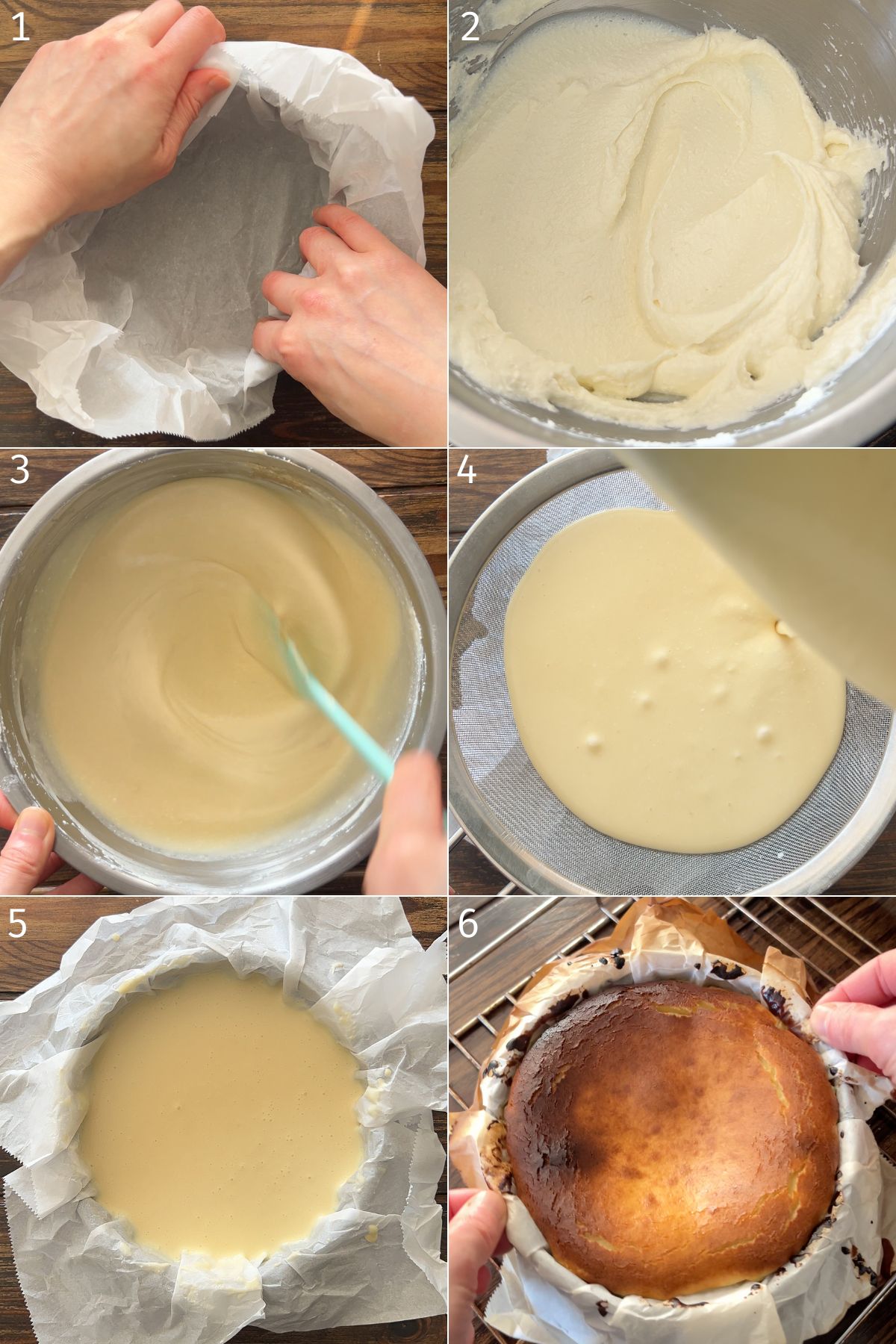
Prepare the Pan
One of the defining features of Basque cheesecake is that it doesn’t have a crust, which means no need to line the pan perfectly or pre-bake anything.
- Crumple a large sheet of parchment paper and press it into your pan. No need to be neat— the creases make it look rustic!
- Make sure there are no rips or holes in the parchment. If there are, add a second layer.
- Ensure the parchment extends at least 1 inch above the edge of the pan since the batter will rise quite a bit during baking.
Cheesecake Batter
- Loosen the room temperature cream cheese until smooth. Add the mascarpone and sour cream and mix well.
- In the video, I’m using cream cheese that was frozen and thawed—which is why it looks a bit chunky. But don’t worry! Once it’s baked, you won’t notice at all. So yes, you can use previously frozen ingredients.
- Mix in the sugar until smooth. Stir in the eggs one at a time. Pour in the cream, whisk until smooth. Stir in the melted white chocolate until until fully incorporated. Be sure to scrape the sides of the bowl with a spatula.
- Pass the batter through a fine mesh sieve into the prepared cake pan to remove any lumps and ensure a silky texture. The cheesecake mixture should be fairly runny—don’t worry, that’s exactly how it should be! Swirl a chopstick throughout the batter and tap the pan to remove any air bubbles.
Bake and Cool
- Bake in an oven that has been pre-heated to 450°F/230°C for 26-35 minutes, until the top is dark golden brown and the middle is still jiggly.
- After testing this recipe in several ovens, I’ve found that baking time varies a lot—some ovens bake it in as little as 26 minutes, while others take up to 40 minutes.
- Burntness isn’t the best indicator of doneness. All of the cheesecakes in the photos below have different levels of burntness but were baked to very similar textures—soft and creamy, but still set.
- If your oven has hot spots, rotate the pan halfway through for an even top.
- The Jiggle Test: The best indicator of doneness is the jiggle test. If you prefer a more set cheesecake, bake until jiggly like jello and if you prefer a more melty texture, bake until its jiggly with large waves.
- Once the cheesecake reaches room temperature, cover and chill it in the fridge overnight. I know it’s hard, but this step is so worth it—it allows the cheesecake to fully set and lets the flavors develop.
- Serve! For clean slices, boil some water and pour it into a tall cut. Place a sharp knife in the cup to let it warm up. Wipe the knife dry and slice. Dip, wipe and slice again—repeat for each slice.
Pan Size
I usually use a 15 cm (6-inch) or 18 cm (7-inch) round cake pan when making Basque cheesecake. These sizes give the cake a nice height with that iconic creamy center and deeply caramelized top. The bake time for both is pretty similar.
If you’re using a different size pan, you’ll need to adjust the ingredient amounts and possibly the baking time. Here’s a quick way to figure it out:
Let’s say you want to use a 9-inch (23 cm) pan:
- First, calculate the surface area of the pans (this helps estimate how much batter you need):
- Area of pan=π×r2
- 9-inch (23 cm) pan:
Radius = 23 / 2 = 11.5 cm
Area = 3.14 × 11.5² ≈ 415 cm² - 6-inch (15 cm) pan:
Radius = 15 / 2 = 7.5 cm
Area = 3.14 × 7.5² ≈ 176 cm²
- 9-inch (23 cm) pan:
- Now, divide the larger area by the smaller area: 415/176≈2.36
So if you’re scaling from a 15 cm (6-inch) recipe to a 23 cm (9-inch) pan, multiply the ingredients by around 2.3 for the same height and volume. If you simply double the recipe (2x), it’ll work too—it might just be a bit shorter in height.
VIDEO: Watch How to Make It
Lisa’s Recipe Tips
- Use room temperature ingredients: This helps create a smooth, lump-free cheesecake batter and ensures the cheesecake bakes evenly throughout.
- Strain before baking: Pour the batter through a fine mesh sieve before baking to achieve the smoothest texture possible. This also removes any lumps or miso granules if you’re using miso.
- Rotate halfway during baking: If your oven has hot spots, rotate the cake tin 180 degrees halfway through baking. This helps achieve even, edge-to-edge caramelization. In one of my ovens, the cheesecake browned evenly without rotating, but in another, it needed a turn for an even top.
- Baking temperature and time: Every oven bakes differently. Even between my two ovens, the baking time and the level of browning on top varies. When making Basque cheesecake for the first time, err on the lower end of the baking time. Take notes, and adjust for next time. Even if you slightly overbake it, the texture is still rich and delicious—more like a traditional cheesecake.
- Clean cake slices: For those perfect, clean slices, heat a sharp knife in hot water, then wipe off excess batter after each cut.

Serving Suggestions
I rarely ever eat classic basque cheesecake with anything because it’s so delicious on its own. But sometimes I love to make brûlée basque cheesecake or top it off with some whip cream, my rare cheese whip or homemade berry sauce!
How to Store Basque Cheesecake
- Let the cheesecake cool completely at room temperature before storing.
- Once cooled, wrap it tightly with plastic wrap or aluminum foil and place it in the fridge. It tastes best after an overnight rest, which allows the flavor to deepen and the texture to set.
- Stored properly in the fridge, it will stay fresh for up to 5 days.
Recipe FAQ
Yes, a cracked top is totally normal—and often expected—with Basque burnt cheesecake. Unlike classic cheesecakes, this one is baked at a high temperature, which causes the top to puff, crack, and caramelize deeply. It adds to the rustic charm and flavor. Don’t worry—cracks won’t affect the creamy texture inside!
If your Basque cheesecake isn’t getting that signature dark top, it might be due to a lower oven temperature or your oven running cooler than it reads. Make sure your oven is fully preheated and try moving the rack closer to the top heating element. Every oven is different, so you may need to experiment.
Yes! You can absolutely use a stand mixer or hand mixer to make Basque cheesecake. Add the ingredients to a bowl of a stand mixer in the same order listed. Use the paddle attachment on low speed and stop as soon as the batter is smooth.
Yes, a high-speed blender works well for making a silky smooth Basque cheesecake batter. Just blend until smooth, but avoid over-blending which can heat the batter and add excess air. If your blender isn’t very powerful, you may want to strain the batter afterward for the smoothest texture.
To add hard cheeses to Basque cheesecake, finely grate the cheese and mix it into the batter after straining. Start with about 1/4 cup, and adjust to taste. Manchego, Idiazábal, or even Parmigiano add a savory, umami-rich depth that balances beautifully with the sweetness and creaminess.

Enjoy!! If you make this Basque Cheesecake recipe, let me know! Leave a comment, rating and if you decide to share it on socials, tag me on instagram @Okonomikitchen. I’d love to hear from you 😁!
Print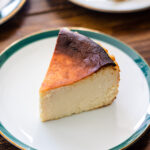
Basque Cheesecake
- Total Time: 45 minutes
- Yield: 8 servings
- Diet: Vegetarian
Description
This Burnt Basque Cheesecake recipe features a perfectly caramelized crust and a creamy, rich interior, making it a standout dessert from the Basque region of Spain. Crustless and easy to make with minimal ingredients, it requires no water bath or special pan. With a few secret ingredients and expert tips, this cheesecake bakes up smooth, melt-in-your-mouth perfect every time!
Ingredients
Classic Recipe
- 1 cup + 1/2 cup + 2 tbsp (400 g) full fat block cream cheese
- 1/2 cup (110 g) granulated white sugar
- 2 large (100 g) eggs
- 2 egg yolks (36 g)
- 1 cup + 3 tbsp (285 ml) heavy cream
- 2 tsp vanilla extract, optional
Adapted Recipe
- 1 cup + 3 tbsp (300 g) full fat block cream cheese
- 1/3 cup (80 g) mascarpone*
- 3 tbsp (45 g) full fat sour cream*
- 1/3 cup (70 g) granulated white sugar
- 3 (150 g) large eggs, room temperature
- 2/3 cup (160 ml) heavy cream
- 1/2 bar (50 g) high quality white chocolate, melted
Instructions
Classic Version
- Prepare the Pan and Oven: Scrunch a large piece of parchment paper and press it into a 15 cm (6-inch) round baking tin, allowing the paper to come at least 1 inch above the rim. If there are any rips or holes in the parchment paper, add one more layer. Preheat oven to 450°F (232°C).
- TIP: Before starting, make sure that all ingredients are room temperature. If the cream cheese and heavy cream is still cold, heat over a double boiler or microwave for a few seconds in separate bowls. If eggs are straight out the fridge, place in a bowl of hot water for a few minutes.
- Loosen the Cream Cheese: In a large bowl, use a rubber spatula to soften the room-temperature cream cheese until smooth.
- Mix Sugar and Cream Cheese: Add granulated sugar and mix until fully combined and smooth.
- Add the Wet Ingredients: Add the whole eggs and egg yolks one at a time, mixing well after each addition. Stir in the heavy cream and optional vanilla extract. Whisk until the batter is smooth.
- Strain the Batter: Pour the batter through a fine-mesh sieve into the prepared pan to ensure a silky texture.
- Bake: Bake for 26–35 minutes. If the top is still pale at 26 minutes, broil for 2–3 minutes until golden and caramelized. The cheesecake should jiggle out of the oven. For a firmer cheesecake, bake until it jiggles like jelly. For a softer, meltier cheesecake, bake until it jiggles but looks slightly undercooked in the middle.
- Cool and Chill: Let the cheesecake cool in the pan on a wire rack at room temperature. Once fully cooled, cover and chill overnight.
- Serve: Carefully remove the cheesecake from the pan. Bring a pot of water to a boil and pour into a tall cup. Place a sharp knife into the water to warm it up and wipe with paper towel before slicing into the cheesecake. Dip into the water and wipe the knife before slicing each time. Serve and enjoy!
Adapted Version
- Prepare the Pan and Oven: Scrunch a large piece of parchment paper and press it into a 15 cm (6-inch) round baking tin, allowing the paper to come at least 1 inch above the rim. If there are any rips or holes in the parchment paper, add one more layer. Preheat oven to 450°F (232°C).
- TIP: Make sure all the ingredients are room temperature before starting.
- Loosen the Cream Cheese: In a large bowl, use a rubber spatula to soften the room-temperature cream cheese until smooth. Mix in the mascarpone and sour cream. Add granulated sugar and stir together until completely smooth.
- Add the Wet Ingredients: Whisk in the whole eggs, one at a time, ensuring each egg is fully incorporated before adding the next. Stir in the heavy cream.
- Incorporate the White Chocolate: Add the melted white chocolate and whisk until the batter is silky and uniform.
- Strain the Batter: Pour the batter through a fine-mesh sieve into the prepared pan for the smoothest texture.
- Bake: Bake for 26-35 minutes. If the top remains pale at 26 minutes, broil for 2–3 minutes to develop a golden brown surface. The cheesecake should jiggle out of the oven. For a firmer cheesecake, bake until it jiggles like jelly. For a softer, meltier cheesecake, bake until it jiggles but looks slightly undercooked in the middle.
- Cool and Chill: Allow the cheesecake to cool in the pan on a wire rack until it reaches room temperature. Cover and refrigerate overnight.
- Serve: Once chilled, remove the cheesecake from the pan. Slice with a heated knife for clean slices. Enjoy!
Notes
- *mascarpone and sour cream can be substituted for full fat greek yogurt, ricotta or more cream cheese.
- Prep Time: 15 minutes
- Cook Time: 30 minutes
- Category: Dessert
- Method: Baking
- Cuisine: Spanish
Nutrition
- Serving Size: 1 slice
- Calories: 368
- Sugar: 17.1 g
- Sodium: 193 mg
- Fat: 30.9 g
- Saturated Fat: 18.1 g
- Unsaturated Fat: 12.3 g
- Trans Fat: 1.1 g
- Carbohydrates: 17.2 g
- Fiber: 0
- Protein: 6.2 g
- Cholesterol: 189 mg



the recipe mentions thatthe cream cheese needs to be room temperature, what about tje eggs and heavy cream?
Yes! All the ingredients should be room temp so its easier to mix 🙂
Hey! Could you please tell me what size pan you used for these measurements?
Thank you!
Hi, Yes so sorry I’ll update the recipe but its 15 cm! 🙂
Made this recipe a couple of days ago and it was delicious. The addition of the miso and white chocolate is genius! Very creamy and easy to make.
my girlfriend made this for me and it was incredible!
The easiest and creamiest cheesecake I’ve ever made. The sieve trick makes such a huge difference!