
This Florentine Sablé Cookies recipe features a buttery sablé cookie base topped with a rich, caramelized almond nougat, offering a delightful combination of textures and flavors. A beloved treat in French patisserie, it’s perfect for any occasion, from tea time to special celebrations. Try this simple recipe to create a truly elegant and delicious dessert.

Table of Contents
What is Sablé Florentine?
Sablé Florentine (Florentine Sablés or Almond Florentine Sable Cookies) is an elegant French pastry that features a buttery, crumbly sablé cookie base topped with a rich, caramelized almond mixture. The sablé base provides a delicate texture, while the Florentine topping, made with almonds, honey, and caramelized sugar, adds a sweet and crunchy contrast. This delicious cookie is perfect for tea time, special occasions, or as a homemade gift, offering a sophisticated balance of flavors and textures that everyone loves!
Sablé Florentine is highly popular in Japan, often found in high-end confectionary stores known for their premium sweets. Due to its elegant appearance and refined flavor, it is commonly given as a gift during special occasions like White Day, Valentine’s Day, and Christmas. Its luxurious combination of textures makes it a sought-after treat for gifting during these celebrations.
Ingredients for Florentine Sablés
Here are the key ingredients you’ll need to make these florentine sablé cookies:
- Butter: The base fat that provides richness and flakiness to the cookie. It’s essential for the soft, crumbly texture of the sablé dough. The butter should be at room temperature to ensure it mixes smoothly with other ingredients.
- Icing Sugar: It dissolves quickly and gives the cookies a tender crumb compared to regular granulated sugar.
- Egg: Adds moisture and helps bind the dough together. The egg also helps with the structure and texture of the final cookie.
- Almond Flour: It gives the cookies a slightly rich taste and contributes to their delicate crumb.
- All-purpose Flour: It gives the cookies a firm but tender texture when combined with the butter and sugar.
- Sliced Almonds: The key element for the Florentine topping. Roasted almonds add a crunchy texture and nutty flavor, complementing the soft, buttery sablé base.
- Sugar: Sweetens the nougat topping and helps it caramelize. It creates a smooth, golden finish once baked.
- Honey: Adds sweetness and a slight floral note to the nougat topping. Honey helps with binding and contributes to the chewy texture of the Florentine layer.
- Corn Syrup: Helps prevent crystallization of the sugar and gives the nougat topping a smooth, glossy finish. It helps achieve a chewy yet firm texture.
- Cream: Adds richness and moisture to the nougat topping, helping it come together smoothly and creating a luxurious texture when baked.
How to Make Florentine Sablé Cookies
These french-style florentine sables are relatively easy to make as long as the instructions are followed correctly, but do take some time. I recommend reading over the tips section to make sure it comes out correctly! Here’s a rundown of how to make florentine cookies:

- Make the dough: Add the ingredients to a food processor and pulse blend until a dough ball forms. Alternatively, cream room-temperature butter with icing sugar until fluffy. Add the egg in batches, mixing well. Fold in the sifted flours to form a crumbly dough.
- Roll & Shape dough: Roll out the dough into the size of your pan between two pieces of parchment paper. Place into the fridge or freezer to firm up.
- Pre-bake: Place dough on a buttered and parchment-lined baking sheet. You can also press it into your pan but it’s a bit more difficult to make it a smooth surface. Poke holes in the dough with a fork. Bake dough at 170°C for 15 minutes or until lightly golden.
- Roast almonds: Toast the sliced almonds in a pan over medium heat. Add the almond slices to a skillet, and stir frequently for 3-5 minutes until golden and fragrant. Alternatively, toast the sliced almonds for 6 minutes in a pre-heated oven at 160°C until lightly browned.
- Make topping: In a saucepan, heat butter, sugar, honey, glucose syrup, and cream until boiling. Stir in roasted almonds.
- Add topping: Spread the almond mixture over the pre-baked dough.
- Final bake: Bake at 170°C for 15-18 minutes or until golden and bubbly.
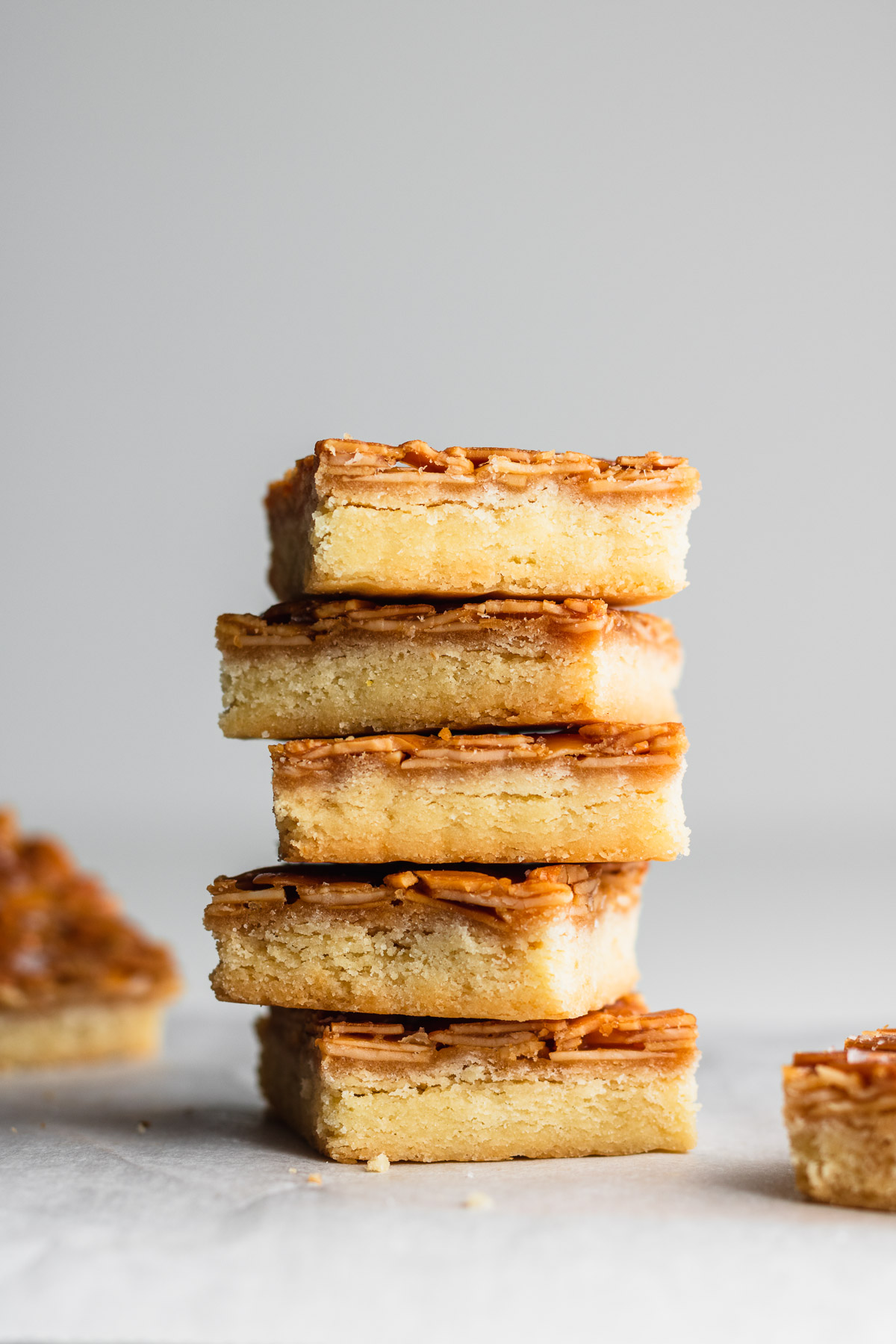
- Cool and cut: Let cool, then cut into pieces while still slightly warm. When cutting, cut straight down with a vert sharp or serrated bread knife for clean cuts.
Lisa’s Recipe Tips
- Use a food scale: As always, for baking cookies I always recommend using a food scale for best and accurate results!
- Ensure Butter is at Room Temperature: If it’s too cold, it won’t mix properly, and if it’s too warm, it may melt.
- Shaping the Dough: I love using the plastic bag method or cling wrap method to pre-roll the dough and then chilling it. It’s much easier to roll out than chilled dough and it because it’s encased in a pre-shaped bag or wrap, the cookie dough is much more likely to be even.
- Roast the Almonds First: Roast the almonds at 160°C for 6 minutes before using them in the topping. This step ensures that the almonds cook properly and add a delicious, toasted flavor to the Florentines.
- Use Parchment Paper to Prevent Sticking
- Line the baking sheet with parchment paper and brush a thin layer of butter on it before placing the dough. This ensures that the dough doesn’t stick and helps with easy removal after baking.
- Be Careful Not to Overheat the Topping: When preparing the almond topping, heat the butter, sugar, and honey just until boiling, but don’t overheat. Caramelizing the topping at this stage can cause it to burn when baked.
- Cut the Florentines While Warm: After baking, let the Florentines cool slightly, but cut them while they’re still a little warm. Once fully cooled, the cookies become hard and difficult to cut neatly. Use a serrated knife (like a bread knife) to cut into neat squares or rectangles.
- For aesthetics: To make neat pieces, I recommend slicing off 1/2-1 cm of the edges where the caramel drips down. After slicing the pieces, use a pastry brush to brush off any crumbs.
How to Store Florentine Cookies
- Cool Completely: Let the cookies cool completely to room temperature after baking. This prevents condensation from forming inside the storage container, which can make them soggy.
- Layer with Parchment Paper: If you need to stack them, place parchment or wax paper between layers to prevent the cookies from sticking to each other.
- Airtight Container: Store the cookies in an airtight container to keep them crisp. You can keep them at room temperature for up to 1 week.
- Freezing: If you’d like to keep them for longer, you can freeze the cookies. Wrap them tightly in plastic wrap or foil, then place them in an airtight container or freezer bag. They can be stored in the freezer for up to 2-3 months. Thaw at room temperature before serving.
Recipe FAQ
Yes! You can easily make them vegan be swapping the eggs for a plant based alternative like a flax egg or Just Egg. As well, use dairy free butter and dairy free heavy cream.
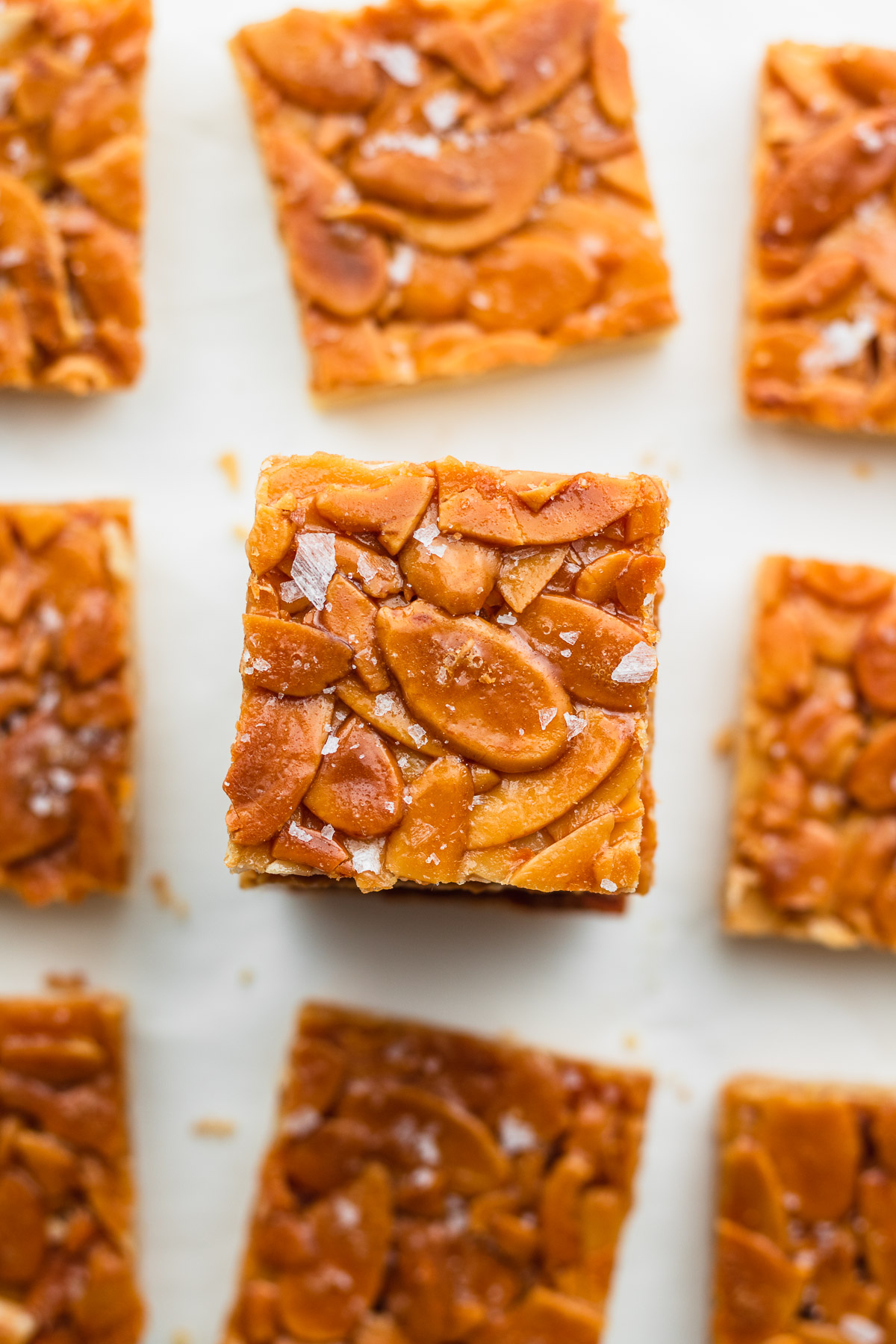
Enjoy!! If you make this Florentine Sablé Cookies recipe, let me know! Leave a comment, rating and if you decide to share it on socials, tag me on instagram @Okonomikitchen. I’d love to hear from you!
Print
Florentine Sablé Cookies
- Total Time: 1 hour 35 minutes
- Yield: 16 pieces
Description
This Florentine Sablé Cookies recipe features a buttery sablé cookie base topped with a rich, caramelized almond nougat, offering a delightful combination of textures and flavors. A beloved treat in French patisserie, it’s perfect for any occasion, from tea time to special celebrations. Try this simple recipe to create a truly elegant and delicious dessert.
Ingredients
Sablé
- 5 tbsp (70 g) unsalted butter, cold and cubed
- 1/3 cup (40 g) powdered sugar
- 1/3 (16 g) large egg, beaten
- 1 tbsp (12 g) almond flour
- 3/4 cup + 1/2 tbsp (103 g) all-purpose flour
- 1/4 tsp salt
Nougat Topping
- 3/4 cup (80-90 g) sliced almonds
- 3 tbsp (42 g) unsalted butter
- 1/3 cup (66 g) white sugar
- 1 tbsp (20 g) honey
- 1/2 tbsp (10 g) corn syrup
- 3 tbsp (45 g) heavy cream
Instructions
Sablé Cookie Dough
- Food processor: Add the ingredients to a food processor and pulse blend until a dough ball forms.
- In a bowl: Place the butter in a bowl and use a wooden spatula to cream it until soft and fluffy. Ensure the butter is at room temperature before starting. If it’s too cold, microwave it for 20-second intervals on low power (200W). Add the sifted icing sugar to the butter and mix gently until combined. Gradually add the beaten egg in small portions, mixing well each time to prevent the dough from separating. Continue adding and mixing until fully combined. Sift the all-purpose flour and almond flour into the mixture in two parts, using a rubber spatula to mix lightly in a cutting motion. The dough should be crumbly but not too dry.
- Shape the Dough: Use a 18 x 18 cm plastic bag (or bag that is the same size as your pan if adjusting the yield of the recipe) or prepare cling wrap that is at least 25 x 25 cm. Place the dough in the middle of the wrap and fold the sides to make a 18 x 18 cm square. Roll the dough out evenly, it should be about 0.5 cm in thickness. Place the dough on a baking tray and refrigerate for 30 minutes or freeze for 15 minutes, or until firm.
- Prepare the baking sheet: Brush a baking sheet (slightly larger than the size of the tray) with a thin layer of butter to help the parchment paper stick. Place parchment paper over it, ensuring it hangs over the edges for easy removal after baking.
- Transfer the dough and poke holes: Once the dough is chilled, use scissors to cut down the plastic bag and carefully remove the dough. Trim the edges if needed to fit the baking tray. Place the dough with parchment paper onto the prepared baking sheet. Use a fork to poke holes all over the dough to prevent puffing during baking.
- Pre-bake the dough: Bake the cookie base in a preheated oven at 170°C (340°F) for about 15 minutes or until lightly golden brown. In the meantime, make the topping below.
Making the Nougat Topping
- Roast the almonds: Toast the sliced almonds in a pan over medium low heat, stirring often until lightly browned. Alternatively, you can toast the almonds in the oven at 160°C (320°F) for 6 minutes or until lightly browned.
- Prepare the caramel: In a saucepan over medium heat, combine the butter, sugar, honey, corn syrup, and cream. Stir occasionally until it starts to boil and heat until 110 C (it takes about 5-10 seconds once boiling). Remove from heat.
- Add the almonds: Stir in the roasted almonds, mixing gently to coat them in the caramel.
- Spread the topping: While the cookie base is still hot, spread the almond mixture evenly over the surface, using a spatula to smooth it out.
Finishing the Cookies
- Bake again: Return the tray to the oven and bake at 170°C (340°F) for 15-18 minutes, until the topping is golden brown and bubbly.
- Cool and cut: Once baked, remove from the oven and allow to cool on a wire rack. While still slightly warm and with the cookie base facing up, use a serrated knife to slice the edges off (about 1/4 inch or 1/2 cm). This step is optional but it creates even and neat pieces. Then cut into squares or rectangles to your liking.
Notes
- In the photos I have used a baking pan that is 16×21 cm. I have scaled the recipe to fit a more universal pan size of 18×18 cm. In the photos I have cut them into 5x5cm square pieces.
- Prep Time: 60 minutes
- Cook Time: 35 minutes
- Category: Dessert
- Method: Baking
- Cuisine: French
Nutrition
- Serving Size: 1 serving
- Calories: 150
- Sugar: 8.9 g
- Sodium: 48 mg
- Fat: 9.9 g
- Saturated Fat: 4.5 g
- Unsaturated Fat: 4.5 g
- Trans Fat: 0.2 g
- Carbohydrates: 14 g
- Fiber: 1.2 g
- Protein: 2.5 g
- Cholesterol: 21 mg
Okonomi Kitchen is a participant in the Amazon Services LLC Associates Program. When you purchase something through my amazon affiliate links, I earn a small commission that helps me produce consistent content at no cost to you. Thank you for your support!




These look elegant and delicious! Just wanted to confirm whether using 1/3 of one egg is correct? It seems like a very small amount (especially to be added in separate small portions), and I noticed that it was listed directly below 1/3 cup powdered sugar so I wanted to double-check that the amount wasn’t an error. Thanks!
yes its 1/3! I usually make a really big batch that uses more eggs which is why i add it in additions but you’re right, its very small so it should mix in easily 🙂
Thank you for the clarification! Can’t wait to make these beauties! 🙂